



Phd proposal: Chicory intercropping boosts sustainable vineyard productivity and resilience

Project title: Optimization of agricultural practices: using chicory as an intercrop to enhance vineyard sustainability and productivity

Current agricultural practices are increasingly criticized due to the toxicity of phytosanitary products used in conventional agriculture, as well as copper-based products employed in organic farming. Chicory (Cichorium intybus), recognized for its robustness and hardiness (Hilbert and Rambaud, 2023), represents a significant reservoir of beneficial microorganisms, both at the rhizospheric and endophytic levels (Leclercq L., manuscript in preparation). These microorganisms provide chicory with enhanced tolerance to various environmental stresses, including metals, as well as a proven ability to solubilize phosphate (Leclercq et al., 2025) and to accumulate metals in its roots (Guérin et al., 2022; Wu et al., 2023; Bonisseau, 2024). As an intercrop, chicory shows promising potential for improving soil quality, increasing nutrient availability, and reducing residues of metals and other contaminants, thereby making soils healthier and nutrients more accessible to main crops such as grapevine.

Project title: Optimization of agricultural practices: using chicory as an intercrop to enhance vineyard sustainability and productivity


Name(s) of the supervisor(s) (affiliation/institution):

Director 1: Jean-Louis HILBERT, Professor, University of Lille (ULille), UMRT BioEcoAgro, Team 5, Chic41H Team (France)

Co-director : Anca LUCAU-DANILA, Associate Professor (MCF), HDR, University of Lille (ULille), UMRT BioEcoAgro, Team 5, Chic41H Team (France)

Director 2: Alicia POU MIR, PhD, CSIC-UR-GR Instituto de Ciencias de la Vid y del Vino (ICVV), Logroño (Spain)

Existing or potential collaboration within the UMRT:

Existing or potential collaboration outside the UMRT: Joint international PhD supervision.  The Spanish supervisor will submit a parallel application to ICVV.


BRIEF DESCRIPTION OF THE RESEARCH TOPIC (maximum 1 page):

Current agricultural practices are increasingly criticized due to the toxicity of phytosanitary products used in conventional agriculture, as well as copper-based products employed in organic farming. Chicory (Cichorium intybus), recognized for its robustness and hardiness (Hilbert and Rambaud, 2023), represents a significant reservoir of beneficial microorganisms, both at the rhizospheric and endophytic levels (Leclercq L., manuscript in preparation). These microorganisms provide chicory with enhanced tolerance to various environmental stresses, including metals, as well as a proven ability to solubilize phosphate (Leclercq et al., 2025) and to accumulate metals in its roots (Guérin et al., 2022; Wu et al., 2023; Bonisseau, 2024). As an intercrop, chicory shows promising potential for improving soil quality, increasing nutrient availability, and reducing residues of metals and other contaminants, thereby making soils healthier and nutrients more accessible to main crops such as grapevine.

The PhD project is structured around several complementary objectives:

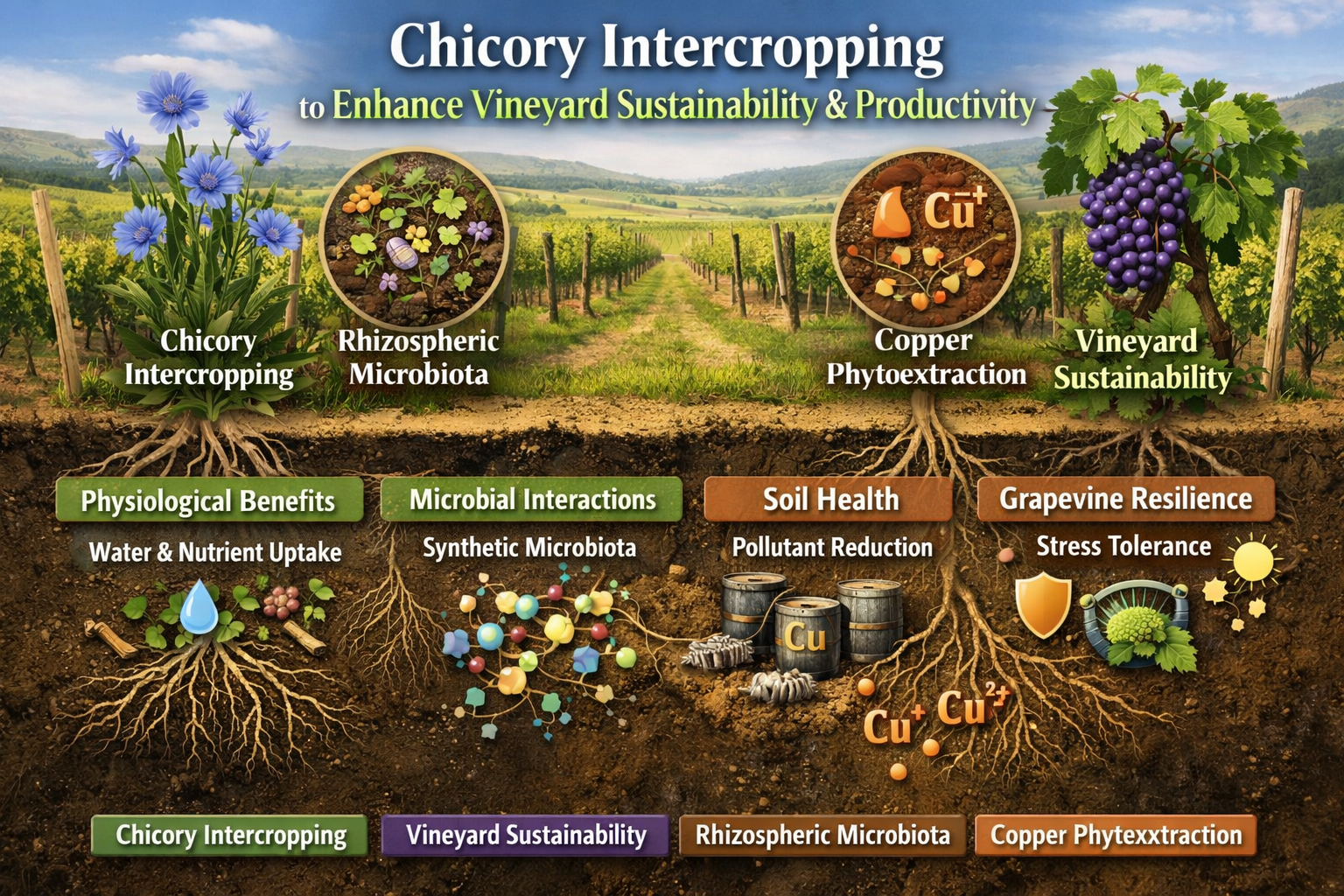
1. Physiological benefits of chicory. A multi-scale experimental setup will be carried out under controlled conditions (greenhouse and growth chambers) as well as in the field, to evaluate nutritional dynamics, water balance, and metal tolerance, with a particular focus on copper, in chicory and grapevine grown either separately or jointly. The potential beneficial effects of chicory under nutritional and water stress, as well as in the context of metal pollution (copper phytoextraction), will be assessed in both species using physiological and transcriptomic approaches (DNA microarrays or RNA-seq), together with ICP-OES (Inductively Coupled Plasma–Optical Emission Spectrometry) to determine copper content.

2. Benefits of the chicory microbiota. The dynamics of the rhizospheric and endophytic microbiota of chicory and grapevine, under the different experimental conditions mentioned above, will be analyzed using metagenomic approaches (NGS sequencing of microbial DNA). Since the microbiota composition of chicory is already well characterized from previous studies, the focus will be on characterizing the rhizospheric and endophytic microbiota of grapevine. Based on this, a synthetic microbiota (SynCom) combining chicory and grapevine will be established from selected beneficial microbial strains. These strains are expected to improve soil resource utilization and increase grapevine tolerance to metals and water stress. The effectiveness of this synthetic microbiota will be evaluated under controlled conditions and then in the field.

3. Study of plant–plant and plant–microbiota interactions. The interaction between chicory, grapevine, and their respective microbiota will be investigated through the analysis of root exudates from both species under different cultivation modalities (plants grown individually, grapevine–chicory co-culture, in the presence or absence of the SynCom). Qualitative and quantitative analyses of exuded compounds will be carried out using metabolomic approaches (NMR, LC-MS), followed by interpretation of the results in relation to previously obtained microbial profiles.

The plant material required for the project will be provided by the company Florimond Desprez, partner of the University of Lille within the Chic41H joint research team (for chicory), and by ICVV Spain (for grapevine). Greenhouse and growth chamber experiments will be conducted at the University of Lille, while field trials will take place in France (in collaboration with the University of Reims) and in the semi-arid region of La Rioja (ICVV, Spain). The PhD candidate will therefore collaborate with members of the Chic41H team at the University of Lille, the Induced Resistance and Plant Bioprotection team – USC INRAE 1488 at the University of Reims Champagne Ardenne, and researchers from ICVV Spain.


References

• Bonisseau (2024) La chicorée pour dépolluer le cuivre. Institut Français de la Vigne et du Vin, https://www.vignevin.com/article/vitalicuivre/

• Guérin, T., Ghinet, A., & Waterlot, C. (2022). The phytoextraction power of Cichorium intybus L. on metal-contaminated soil: Focus on time- and cultivar-depending accumulation and distribution of cadmium, lead and zinc. Chemosphere, 287(Part 1), 132122. https://doi.org/10.1016/j.chemosphere.2021.132122

• Hilbert, J.-L., & Rambaud, C. (2023). Industrial chicory and its specialized metabolites: Diversification of uses and varietal selection. In J. L. Hilbert & C. Rambaud (Eds.), Natural Products in Beverages (pp. 1–35). https://doi.org/10.1007/978-3-031-04195-2_134-1

• Leclercq L, Debarre S, Lloret E, Taminiau B, Daube G, Rambaud C, Drider D, Siah A, Desprez B, Hilbert JL, Lucau-Danila A (2025) Unveiling the hidden allies of industrial chicory: A metagenomic exploration of rhizospheric microbiota and their impact on productivity and plant health. Frontiers in Microbiology, ID 1509094,16. https://doi.org/10.3389/fmicb.2025.1509094

• Wu, S., Yang, Y., Qin, Y., Deng, X., Zhang, Q., Zou, D., & Zeng, Q. (2023). Cichorium intybus L. is a potential Cd-accumulator for phytoremediation of agricultural soil with strong tolerance and detoxification to Cd. Journal of Hazardous Materials, 451, 131182. https://doi.org/10.1016/j.jhazmat.2023.131182

Contact

Applications and inquiries should be sent to Anca Lucau (anca.lucau@univ-lille.fr)