1) Selected Research Topic and its Scientific and Economic Context
The cosmetic market represents a significant share of the French economy (estimated at €220 billion in 2019 according to the L’Oréal Finance website). France holds a strong position worldwide, benefiting from the luxury image of its brands and the international reputation of French expertise. This sector is highly dynamic and rapidly expanding.
In recent years, public awareness of the environmental impact of consumption has increased. As a result, the cosmetic industry, like many others, must adapt to these new constraints in order to remain attractive to consumers. Consumers are increasingly turning toward natural products, mainly of plant origin, which are perceived as healthier and more environmentally friendly. Consequently, there is a growing demand for natural products in several sectors (food, packaging, pharmaceuticals, and cosmetics) and for reducing the use of compounds derived from chemical synthesis and petrochemistry.
In 2018, the French organic cosmetics market generated €757 million in revenue. Among the many cosmetic products available on the market, skincare products represent a major segment of the French cosmetics market, accounting for approximately 40%.
Within skincare products, some formulations aim to prevent skin damage caused by the accumulation of reactive oxygen species (ROS) in skin cells, which leads to lipid peroxidation and DNA damage (Afaq and Mukhtar, 2006; Svobodová et al., 2003). Continuous exposure of the skin to environmental conditions (sunlight, UV radiation, pollutants, ozone, etc.) results in a high production of ROS. These species accumulate rapidly in cells and cause oxidative damage that disrupts regulatory pathways and impairs the cellular antioxidant system, ultimately leading to skin damage, aging, and cancer development. ROS-induced skin damage is easily observable through the appearance of redness, wrinkles, localized skin dryness, pigmentation variability, or loss of elasticity (Fisher et al., 2002).
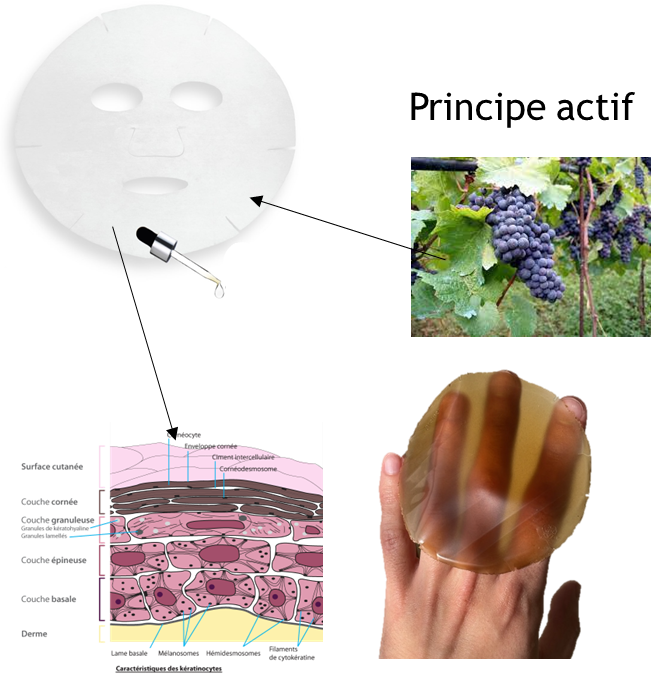
Among the different skincare formulations available, conventional products such as creams and lotions coexist with more innovative formulations such as sheet masks or patches that can be directly applied to a specific target area and are gaining increasing popularity. Although some companies have developed masks made of 100% biodegradable biocellulose to reduce environmental impact, a major limitation remains the distribution of the active ingredient. In most cases, the active compound is not incorporated directly into the mask but only into the accompanying liquid, which must be added in excess and therefore leads to considerable product loss.
This project builds on the context of a first ongoing PhD project, CosmeStil (defense expected in October–November 2025), and the proposed PhD project CosmeCell (planned to start in October 2025). The objective is to establish a new methodology based on a cellular model mimicking the interactions between biomolecules, cosmetic masks, and packaging materials in order to test cosmetic formulations produced using environmentally friendly approaches while ensuring optimal efficacy for skin care.
In the first thesis (CosmeStil), the production of the active ingredient (a mixture of grapevine stilbenes) was achieved under controlled conditions through hairy root cultures, allowing extraction in a single step using limited amounts of non-toxic solvents approved for cosmetic industry use (ethanol). Purification to a single molecule is not required since the complex extract is characterized, its non-cytotoxicity has been verified, and it remains reproducible between batches.
The active ingredient support was also formulated using film-forming molecules derived from natural sources (microorganisms or plants) recovered from previous productions, such as outdated craft brewing batches or culture residues, following principles of circular economy and recycling of regional waste.
In this new thesis project (CosmeCell), the safety of all ingredients will be validated individually and after formulation. The main originality of the project lies in the development of an in vitro 3D skin model constructed from keratinocyte cultures to evaluate how the active ingredient behaves in relation to the skin barrier effect, particularly the proportion of molecules that can be absorbed or metabolized by the skin, as well as the potential health benefits of the masks, such as anti-inflammatory effects.
In a second phase, the stability of formulated products and active compounds will be studied to determine optimal preservation methods.
2) Current Status of the Topic in the Host Laboratory
The PhD will be carried out within the Sol4Health team, specifically between the University of Lille and colleagues from UPJV (Université de Picardie Jules Verne). Both laboratories belong to the same joint research unit: UMR-T BioEcoAgro.
This structure brings together researchers from INRAE, the University of Liège, the University of Lille (ULille), and the University of Picardie Jules Verne (UPJV).
The main research themes of the unit focus on:
understanding plant functioning in natural or controlled environments in the context of climate change
the bioproduction of active biomolecules (plant-derived specialized metabolites and polymers, microbial enzymes, and secondary metabolites)
food biopreservation and formulation
The proposed thesis builds on the continuation of a PhD project that will be defended in 2025 and on the SFR Condorcet 2020 project (FLASHBACK), which initiated collaboration with the UPJV team.
These projects have already allowed us to:
demonstrate the safety of the compounds used in the formulations (plant extract, yeast cell wall)
establish proof of concept for the development of cosmetic masks (mask production and integration of plant extracts) and validate their economic viability
begin the development of an in vitro skin model derived from keratinocyte cells
3) Objectives and Expected Results
Following the first thesis ending in 2025, the proposed thesis aims to:
1. Development of a 3D skin model
Development of a 3D skin model based on differentiated keratinocyte cells, validated by immunolabeling, and study of the behavior of model molecules (such as resveratrol).
2. Development of a methodology to test dry cosmetic formulations
Implementation of a cellular analysis strategy using the 3D skin model, including:
evaluation of formulation safety
quantification of molecules absorbed by cells using HPLC analysis
study of activation of cellular antioxidant mechanisms using qPCR
evaluation of anti-inflammatory effects on skin cells
3. Stability study of the developed formulations
Evaluation of:
mechanical and structural stability of the formulation
preservation of the biological activity of the active compound
maintenance of formulation safety and efficacy under different storage and conservation conditions
Overall, this thesis will validate a new rational strategy for cosmetic formulation based on the biological response of a cellular barrier mimicking human skin. Currently, active compounds are often incorporated in excess, which may lead to long-term skin reactions and increased formulation costs.
Advances in the understanding of cosmetic mask mechanisms will result in scientific publications in peer-reviewed journals and presentations at national and international conferences.
These results will also be valuable for other research projects within the UMR-T. The development of 2D and 3D in vitro skin models will provide a tool for screening the activity and bioavailability of specialized metabolites in cosmetic products, with potential applications in the agri-food sector.
Furthermore, the validation of a formulation methodology will support the valorization of metabolites in various fields. Indeed, this type of formulation based on the valorization of agri-food by-products could be applied to food or non-food packaging, medical or nutraceutical capsules, biocontrol, plant growth stimulation, or construction materials. In such cases, only the active compound and the support materials would need to be adapted to the specific biological question to enable industrial applications.