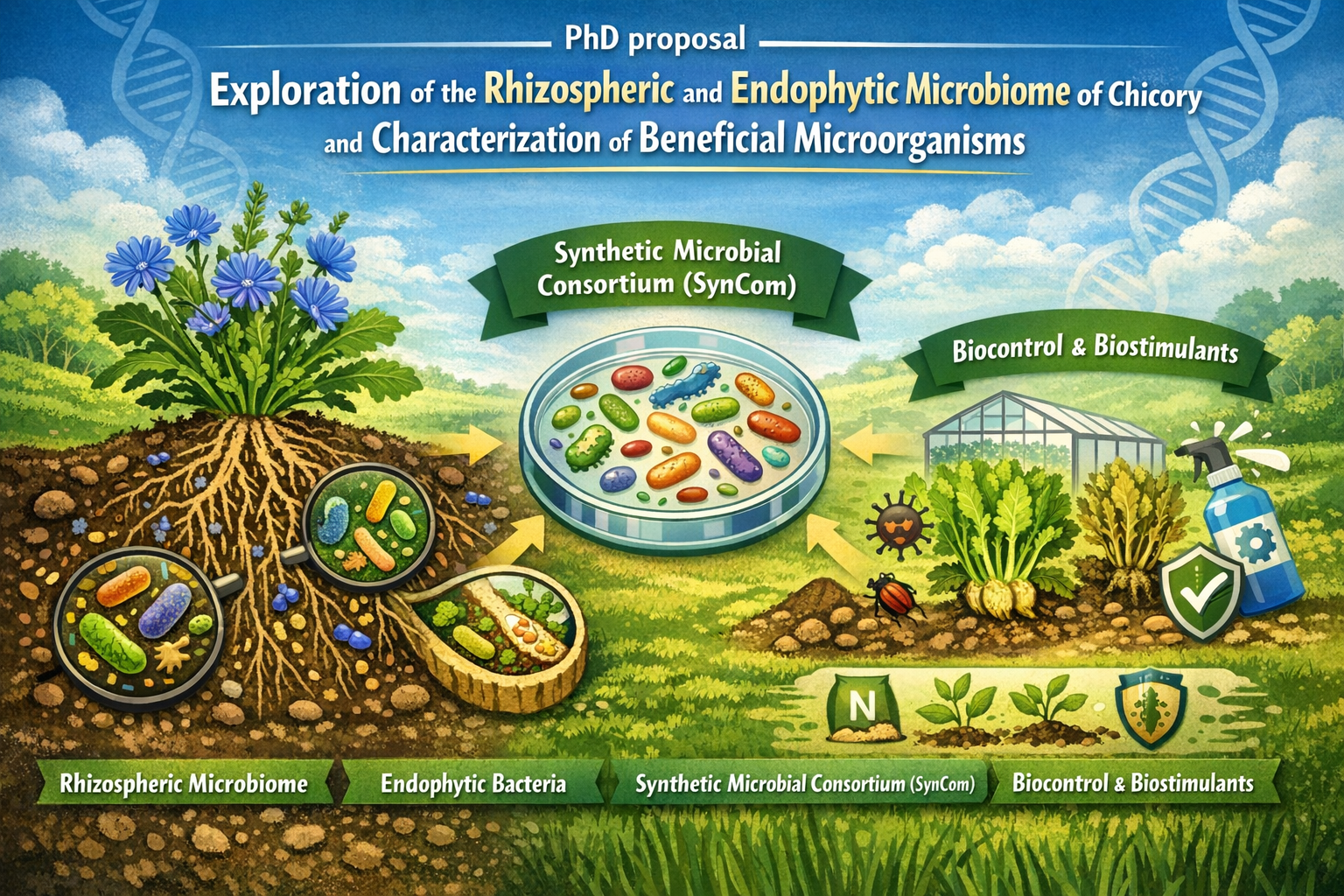
Project title: Exploration of the rhizospheric and endophytic microbiome of chicory and characterization of beneficial microorganisms
Name(s) of the supervisor(s) (affiliation/institution):
Anca LUCAU-DANILA, Associate Professor (MCF), HDR, University of Lille (ULille), UMRT BioEcoAgro, Team 5, Chic41H Team (France)
Marius STEFAN, Professor, Alexandru Ioan Cuza University (UAIC), Faculty of Biology, BioActive Group (Iasi, Romania)
Existing or potential collaboration within the UMRT:
Existing or potential collaboration outside the UMRT: Joint international PhD supervision proposed within the framework of the LAI SOPHYA (Soil Microbiome and Physiology of Agricultural Plants). An application for internationally labelled PhDs will be submitted as soon as the call is open. The Romanian supervisor will submit a parallel application to UAIC.
BRIEF DESCRIPTION OF THE RESEARCH TOPIC (maximum 1 page):
Industrial chicory (Cichorium intybus var. sativum) is recognized as a functional food, and various classes of compounds present in the plant have been identified as responsible for its health benefits in both animals and humans (Fouré et al., 2018; Pouille et al., 2020, 2022, 2022; Kulkarni et al., 2024). The chemical composition of chicory and its derived food products can vary depending on the genotype and cultivation conditions. The microbial ecosystem associated with the plant is also likely to influence its composition. Moreover, climate change — by inducing abiotic (drought, salinity, extreme temperatures) and biotic (increased pathogen pressure) stress — as well as conventional or organic farming practices, can cause major alterations in the growth and resilience of this plant (Suzuki et al., 2014; Lesk et al., 2016; Zandalinas et al., 2017; Poursakhi et al., 2019; Delphine et al., 2022).
Previous studies carried out in our laboratory have highlighted the association of this plant with specific microorganisms forming a characteristic signature (core microbiota), capable of solubilizing phosphate, tolerating drought, salinity, and heavy metals, and promoting growth and resistance to pathogens (Leclercq et al., 2025 and ongoing work).
The overall objective of this project is to quantify these selected beneficial microorganisms associated with industrial chicory and to characterize them at the genomic and functional levels in order to evaluate them as biocontrol agents, biofertilizers, and biostimulants.
The PhD project is structured around several specific objectives:
1. Creation of a synthetic microbial consortium of chicory (SynCom) and its genomic characterization. The aim of this objective is to precisely identify beneficial microorganisms detected through sequencing and also isolated from different compartments of chicory (rhizosphere, roots, embryonic tissues), and to create a consortium (SynCom) of beneficial species by combining genomic sequencing and comparative analysis approaches. This work will include: extraction of genomic DNA from isolated microbial strains, sequencing, assembly, and annotation of microbial genomes. Bioinformatic comparison will be conducted using public databases (NCBI, EzBioCloud, GTDB, etc.) to identify strains at the species and subspecies levels and to detect the presence of genes related to functions of interest (stress tolerance, phytohormone production, phosphate solubilization, etc.). This step aims to establish a precise genetic identity map of the selected microorganisms.
2. Functional characterization of selected microorganisms within the SynCom using microbiological approaches. The goal is to determine the functional potential of the selected microbial strains by evaluating their ability to promote plant growth or enhance resilience to abiotic and biotic stresses. This characterization will be conducted through in vitro microbiological analyses, including phosphate solubilization, phytohormone production, ACC-deaminase activity, tolerance to abiotic stresses (metal, drought, and salt tolerance), production of antimicrobial compounds, biofilm formation capacity, quorum sensing, chemotaxis, motility, and estimation of antagonistic activity.
3. Evaluation of the agronomic potential of the selected microorganisms: biocontrol, biostimulation, and biofertilization effects. This objective aims to test, under controlled (greenhouse) and field conditions, the effects of the selected microbial strains on the growth, resilience, and health of industrial chicory. These trials will assess their potential as biocontrol agents, biostimulants, and biofertilizers, either individually or as a SynCom. Biocontrol tests involve inoculating plants with beneficial microorganisms and then exposing them to specific pathogens to measure the protective effect (symptom reduction, improved tolerance). Biostimulation tests aim to evaluate the effect of microorganisms on plant growth (root development, biomass, leaf area, antioxidant or plant hormone production) in the absence of pathogens. Biofertilization tests target the effect of strains on nutrient uptake (nitrogen, phosphorus, potassium, etc.), particularly via mineral solubilization or nitrogen fixation, under standard or nutrient-limited growth conditions. These tests will be conducted alongside monitoring of agro-physiological, biochemical, and transcriptomic parameters to quantify the overall impact of microorganisms on plant performance. In parallel, the impact of isolated species and the SynCom on the soil microbial ecosystem will be assessed using metagenomic and metatranscriptomic analyses.
The plant material required for the project will be provided by Florimond Desprez, a partner of the University of Lille within the joint Chic41H team.
References
• Delfine, S., Fratianni, A., D’Agostino, A., & Panfili, G. (2022). Influence of drought stress on physiological responses and bioactive compounds in chicory (Cichorium intybus L.): Opportunity for a sustainable agriculture. Foods, 11(22), 3725.
• Fouré, M., Dugardin, C., Foligné, B., Hance, P., Cadalen, T., Delcourt, A., Taminiau, B., Daube, G., Ravallec, R., Cudennec, B., Hilbert, J.-L., & Lucau-Danila, A. (2018). Chicory roots for prebiotics and appetite regulation: A pilot study in mice. Journal of Agricultural and Food Chemistry, 66(26), 6439–6449. https://doi.org/10.1021/acs.jafc.8b01055
• Kulkarni, T. S., Siegien, P., Comer, L., Vandel, J., Chataigne, G., Richel, A., Wavreille, J., Cudennec, B., Lucau-Danila, A., Everaert, N., Ravallec, R., & Schroyen, M. (2024). A comparative study of the effects of crude chicory and inulin on gut health in weaning piglets. Journal of Functional Foods, 123, 106578. https://doi.org/10.1016/j.jff.2024.106578
• Leclercq L, Debarre S, Lloret E, Taminiau B, Daube G, Rambaud C, Drider D, Siah A, Desprez B, Hilbert JL, Lucau-Danila A (2025) Unveiling the hidden allies of industrial chicory: A metagenomic exploration of rhizospheric microbiota and their impact on productivity and plant health. Frontiers in Microbiology, ID 1509094,16. https://doi.org/10.3389/fmicb.2025.1509094
• Lesk, C., Rowhani, P., & Ramankutty, N. (2016). Influence of extreme weather disasters on global crop production. Nature, 529, 84–87. https://doi.org/10.1038/nature16467
• Pouille, C. L., Dugardin, C., Behra, J., Tourret, M., Molinié, R., Fontaine, J.-X., Mathiron, D., Palaric, C., Gagneul, D., Ravallec, R., Rambaud, C., Hilbert, J.-L., Lucau-Danila, A., & Cudennec, B. (2024). Metabolomic monitoring of chicory during in vitro gastrointestinal digestion and correlation with bioactive properties. Food Chemistry, 467, 142344. https://doi.org/10.1016/j.foodchem.2024.142344
• Pouille, C. L., Ouaza, S., Roels, E., Behra, J., Tourret, M., Molinié, R., Fontaine, J.-X., Mathiron, D., Gagneul, D., Taminiau, B., Daube, G., Ravallec, R., Rambaud, C., Hilbert, J.-L., Cudennec, B., & Lucau-Danila, A. (2022). Chicory: Understanding the effects and effectors of this functional food. Nutrients, 14(5), 957. https://doi.org/10.3390/nu14050957
• Pouille, C. L., Jegou, D., Dugardin, C., Cudennec, B., Ravallec, R., Rambaud, C., Hilbert, J.-L., & Lucau-Danila, A. (2020). Chicory root flour – A functional food with potential multiple health benefits evaluated in a mice model. Journal of Functional Foods, 74, 104174. https://doi.org/10.1016/j.jff.2020.104174
• Poursakhi, N., Razmjoo, J., & Karimmojeni, H. (2019). Interactive effect of salinity stress and foliar application of salicylic acid on some physiochemical traits of chicory (Cichorium intybus L.) genotypes. Scientia Horticulturae, 258, 108810.
• Suzuki, N., Rivero, R. M., Shulaev, V., Blumwald, E., & Mittler, R. (2014). Abiotic and biotic stress combinations. New Phytologist, 203(1), 32–43. https://doi.org/10.1111/nph.12797
• Zandalinas, S. I., Mittler, R., Balfagón, D., Arbona, V., & Gómez-Cadenas, A. (2017). Plant adaptations to the combination of drought and high temperatures. Physiologia Plantarum, 159(2), 122–129. https://doi.org/10.1111/ppl.12540